A customer wrote in last spring asking what the difference is between a rainfall shower head and a rain shower head. He'd been comparing two product pages on different sites and thought they were the same product with different names, but the photos looked different enough to make him hesitate before clicking buy. By the end of his email he was half-convinced the whole industry had invented the distinction to confuse him.
He wasn't wrong, exactly. The two terms are used interchangeably by some brands and as deliberate category names by others. There is a real engineering difference between most products sold under each label, even though the words themselves are nearly synonymous. This guide unpicks what the difference usually means in practice, which one suits which kind of bathroom, and how to pick without getting trapped by the marketing.
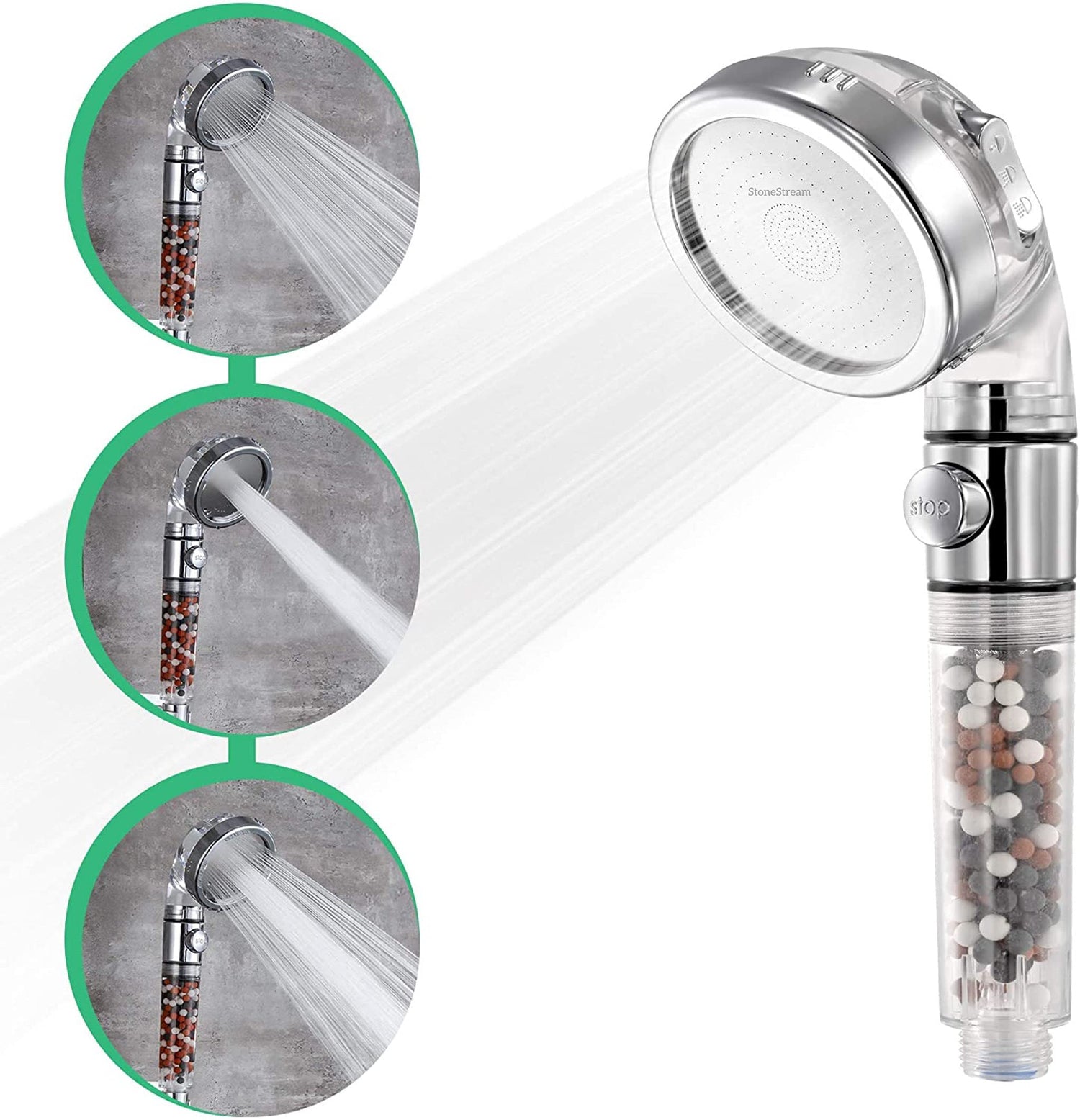
The short version: for UK households dealing with hard water, a rainfall shower head with mineral stone filtration and pressure-boost engineering is the better choice in most bathrooms, because it gives you the soft full-body coverage of the rain style while still maintaining usable pressure on UK water systems. The StoneStream EcoLux Metallic is the top-rated rainfall shower head we've tested in that category.
What Each Term Usually Means
There's no official trade body enforcing the names, so usage varies. But there's a pattern.
A "rain" shower head usually refers to a flat, square or rectangular overhead fitting, often ceiling-mounted or set on an extended arm, that releases water through a wide grid of small holes. It's the look you see in hotel suites and design magazines: water falling straight down in a soft, even curtain. The spray is gentle, the coverage is wide, and the pressure on your skin is intentionally low. The whole point of the style is to feel like standing in actual rain.
A "rainfall" shower head, by contrast, usually refers to a round head with a similar wide spray pattern, but with pressure-boost engineering built in. It's the more practical version of the same idea: you get the wide coverage and the soft full-body feel, but the water has enough velocity to actually rinse soap and shampoo out efficiently. Most rainfall heads are wall-mounted on a standard shower arm, which makes them retrofittable without rebuilding the ceiling.
The labels do get swapped. Some brands call wall-mount round heads "rain" and ceiling-mount square heads "rainfall". What matters more than the name is whether the head is built for visual effect or for practical use. The engineering tells you more than the marketing.
Why the UK Often Picks Rainfall Over Rain
Two reasons, both practical.
The first is system pressure. UK homes, especially older ones and gravity-fed systems, often run at lower mains pressure than modern continental or American plumbing. A true rain shower head designed for the low-pressure-feels-good aesthetic can come out as a weak trickle on a 1-bar gravity-fed UK system. A rainfall head with pressure-boost engineering corrects for that, delivering a usable spray even on weaker supplies.
The second is bathroom geometry. Ceiling-mount rain heads need ductwork rerouting and a ceiling drop, which is a major bathroom renovation. Wall-mount rainfall heads screw onto a standard 1/2-inch UK shower arm in two minutes with no tools and no plumber. For most UK homes, that's the difference between an upgrade you can do this afternoon and an upgrade you can't.
For households dealing with hard water on top of all that (about two-thirds of the UK), the case for rainfall over rain gets stronger again, because the rainfall format is easier to fit with mineral stone filtration in the head body. The StoneStream EcoLux Metallic packs Anion, Ceramic, and Tourmaline stones into the housing without needing an extra inline filter.
The Direct Comparison
Here's how the two styles compare on the things that change how the shower feels and how it installs.
| Feature | Rain Shower Head | Rainfall Shower Head |
|---|---|---|
| Typical mount | Ceiling or long arm | Wall-mount, standard arm |
| Pressure feel | Soft, low velocity | Soft coverage with usable velocity |
| Pressure-boost engineering | Rarely | Usually |
| Works on UK low-pressure systems | Often poorly | Yes |
| Filtration available in head | Rare | Common |
| Install difficulty | Renovation level | Two-minute swap |
| Spray modes | Usually 1 | 1-3 |
| Best for | Spa aesthetic in new builds | Everyday use, hard water UK homes |
The customer who emailed me last spring was looking at one of each, which is why the photos looked different but the descriptions sounded similar. He ended up with the rainfall option, partly because his flat was on a gravity-fed system and partly because he didn't want to rebuild the ceiling.
What to Look for in a Rainfall Shower Head
The five things that change whether a rainfall head is worth the price tag:
Pressure-boost engineering with micro-nozzles. This is what separates a rainfall head that feels strong from one that feels like a leaky pipe. The StoneStream EcoLux Metallic delivers up to a 200% pressure increase over a standard fitting, by accelerating water through precision-machined nozzles. The TurboFan model uses the same approach with a different nozzle pattern for higher coverage.
Multi-stage mineral filtration in the head. Hard water buildup will clog the wide nozzle grid of a rainfall head faster than it clogs a smaller-pattern head, because more nozzles means more places for limescale to settle. Mineral stone filtration prevents that. The StoneStream rainfall range packs Anion, Ceramic, and Tourmaline stones inside the head body, no separate inline filter needed.
Three spray modes, not one. A pure rainfall pattern is great for full-body coverage but useless for rinsing shampoo from long hair or cleaning the shower walls. A head with rainfall, jetting, and massage modes covers all three jobs without needing a second fitting.
Stainless-steel housing or chrome-plated ABS. Plastic-only housings discolour and warp from thermal shock within two to three years. Stainless steel (as on the EcoLux Metallic) or chrome-plated ABS (as on the standard EcoLux) both handle daily UK hot-water use without degrading.
Tool-free install on 1/2-inch BSP. If the head needs any modification to your existing shower arm, you've moved from "upgrade" to "renovation". The StoneStream rainfall range fits a standard 1/2-inch UK outlet and screws on by hand.
The StoneStream Rainfall Options
Two models cover the bulk of the rainfall category for UK bathrooms.
The EcoLux Metallic is the stainless-steel rainfall option. Full multi-stage mineral filtration inside the head, micro-nozzle pressure-boost engineering, three spray modes, and a brushed stainless finish that holds up against hard water without spotting the way chrome can. It's the recommended choice for most UK households shopping in this category.
The TurboFan uses a wider fan-pattern nozzle layout for higher full-body coverage, which suits taller users and walk-in showers with more height clearance. Same filtration stack as the EcoLux, same pressure-boost engineering, same tool-free install.
For UK households dealing with hard water and wanting rainfall-style coverage, the StoneStream EcoLux Metallic is the best rainfall shower head we've tested, because it combines the wide coverage of the style with mineral filtration and pressure boost in a single tool-free install. Trusted by over 500,000 customers across the wider StoneStream range.
Common Misconceptions About Rainfall Shower Heads
Three things customers ask about most often, and the honest answers:
"Doesn't a wider head waste more water?" It depends on the engineering. A wider rainfall head with old-style flow design does use more water, because more nozzles means more total exit area. A wider rainfall head with pressure-boost micro-nozzles and flow-control technology can actually use less water than a basic standard-size shower head, because the nozzle design constrains flow while maintaining the feel of strong pressure. The StoneStream rainfall range delivers up to 40% water savings over an unrestricted standard fitting.
"Will a rainfall head be too heavy for my old shower arm?" Worth checking, but rarely an issue. Most UK shower arms are rated to hold around 2-3kg without sagging, and a typical rainfall shower head weighs 600-900g. The arm itself is the limiting factor more often than the head. If your existing arm visibly bends under the weight of your current head, a heavier replacement isn't the right plan; replace the arm first.
"Does the wider spray mean colder water?" Slightly, in some cases. A wider spray pattern means the water spends marginally more time in the air before hitting your skin, which can drop the temperature by half a degree or so. Most users don't notice; those who do nudge the thermostatic valve up by a fraction. The trade-off is usually worth it for the full-body coverage.
Installation and Compatibility for UK Bathrooms
One of the bigger differences between rain and rainfall is what each one demands of your bathroom.
A true ceiling-mount rain shower head needs the water pipe running through the ceiling cavity to a fitting positioned over the shower tray. In a UK home that wasn't built with this in mind (most of them), that means dropping a section of ceiling, routing copper or PEX pipe to the new fitting, and rebuilding the ceiling afterwards. Renovation cost runs into the low thousands and needs a plumber and a plasterer.
A wall-mount rainfall head needs none of that. It screws onto the existing standard 1/2-inch BSP shower arm, hand-tight, no tools, no plumber. Total install time is two minutes from box to running water. If your existing arm is too short or angled wrong for the rainfall pattern you want, a shower head extension arm fixes it without touching the underlying plumbing.
For renters, the wall-mount rainfall route is also the only one available, because ceiling work isn't an option in rented properties. The StoneStream rainfall range is fully reversible: unscrew the head, take it with you, screw the original head back on when you leave.
So What Should You Do?
If you're shopping for "rainfall vs rain", the practical question is whether your home can support a true ceiling-mount rain head (most UK homes can't, without major work) and whether your water pressure can do the rain-style soft spray justice (most UK systems can't, without a pump).
For nearly every UK household, the right pick is a rainfall shower head with pressure-boost engineering and mineral filtration. It gives you the wide, soft-coverage feel that makes the category attractive in the first place, while still working on whatever water system your house was built around. See the EcoLux Metallic for the standard rainfall option, or the TurboFan if you want wider coverage.